
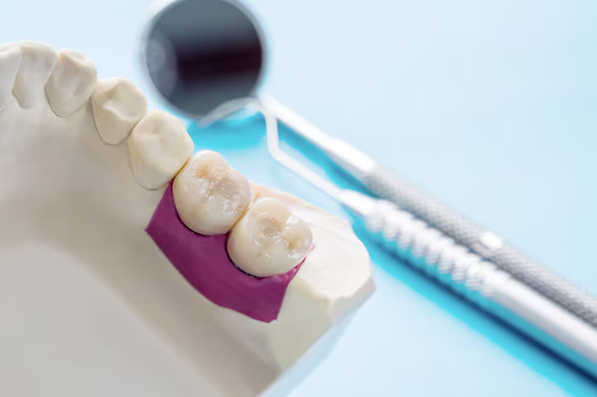
A dental bridges Winchester KY is a fixed prosthetic device used to replace one or more missing teeth by attaching artificial teeth (pontics) to adjacent natural teeth or dental implants (abutments). Restoring chewing function, these dental restorations enhance smile appearance, prevent adjacent teeth from moving, and usually endure with adequate maintenance for 5–15+ years.
Varieties of Dental Bridges
Conventional Fixed Dental Bridge.
A traditional dental bridges Winchester KY is made up of a fake tooth or teeth that are secured in place by dental crowns, which have been cemented onto each of the supporting teeth. A traditional dental bridge is typically the most popular type of dental bridge and can be used when there are natural teeth on both sides of the gap created by a missing tooth.
Overhanging Dental Bridge
Similar to a conventional bridge, the pontic in a cantilever dental bridge is secured by a dental crown that is cemented to just one abutment tooth. For a cantilever bridge, one single natural tooth adjacent to the missing tooth gap is required.
Maryland Dental Bridge.
Like a conventional bridge, Maryland dental bridges Winchester KY utilize two natural support teeth, one on either side of the gap. In contrast to traditional bridges, which employ dental crowns on the abutment teeth, Maryland bridges utilize a framework of either metal or porcelain that is bonded onto the backs of the abutment teeth.
Similar to a conventional bridge, a Maryland bridge can only be utilized when you possess a natural tooth on each side of the space created by the missing tooth or teeth.
Fixed Dental Bridge Supported by Implants
As the name suggests, implant-supported bridges rely on dental implants rather than crowns or frameworks. Generally, a single implant is surgically positioned for each missing tooth, with the implants supporting the bridge's placement. If a separate implant for each missing tooth is not feasible, the bridge may have a pontic suspended between two crowns supported by implants.
Generally regarded as the most robust and stable option, an implant-supported bridge typically necessitates two surgical procedures.
The first step involves inserting the implants directly into the jawbone.
A subsequent operation to install the bridge.
It typically takes several months to complete the procedure entirely.